Showing posts with label bashar al asad. Show all posts

Thursday, July 18, 2013

Syria in the US-Saudi-Israeli prism

by Zafar Bangash Events in Syria are not entirely based on domestic factors. There are three other conflicts underway that are all being played out through the struggle in Syria. No conflict in any society anywhere in the world is entirely due to internal factors. There are always external players that exploit internal divisions to advance their own agendas. This is even more so in Syria that lies at the confluence of numerous political fault lines and where the interests of many powers collide. While at a superficial level, it can be said that the Syrian people were motivated by the same desire as people elsewhere in the Muslim East — Tunisia, Egypt et al. — to seek freedom and have a greater say in governance, it would be wrong to assume that this was entirely a domestically inspired movement. Enough evidence exists, courtesy of Syrian opposition sources, to confirm that the plot was hatched outside Syria, to wit, in Paris under the auspices of the Americans, Israelis and Saudis in February 2011. Events in Syria must be understood against the backdrop of three other conflicts: the Israeli-Saudi struggle against Iran for regional influence; US-Russian power struggle for regional domination, and the US-Iran struggle for ideological influence. In all three arenas, the US and its allies have suffered setbacks. Turkey and Qatar have also joined the US-Saudi-Israeli nexus against Syria, and by extension Iran. The Syrian opposition’s offer of talks with Damascus, albeit with caveats, is proof that some of them have understood the regional dynamics. They have come to realize who wields the most power and influence in the region. It is not Riyadh, Tel Aviv, Ankara or Washington; it is Tehran. And Islamic Iran can be relied upon to play the role of honest broker, unlike the duplicitous Americans and devious Saudis. The plot to weaken the resistance front against Zionist Israel has ended up weakening the gang of conspirators and the setback they have suffered in Syria will unravel their other devilish plots as well. Let us start with Russia’s role in the Syrian crisis. By refusing to cede control of Syria that would have turned the Mediterranean into an American lake, Moscow served notice that there will be no repeat of the Libya scenario. Both Russia and China felt betrayed by the manner in which a UN no-fly zone resolution on Libya was turned into a shooting rampage decimating Colonel Muammar Qaddafi’s forces and infrastructure. Once the US-NATO war was unleashed, there was little that Moscow or Beijing could do to stop it. Unlike Libya however, Syria is of great interest to Russia. There is a 40-year long relationship; Syria is the biggest importer of Russian arms in the region and there is a Russian naval base at Tartus. Russia had too much to lose and it refused to roll over at the UN leading to the use of three vetoes against US-sponsored resolutions that would have authorized a NATO attack on Syria. China, too, sided with Russia. Next came the US-Saudi-Israeli nexus that wanted to cut an important arm of the resistance front against Zionist Israel. For its own reasons that we need not go into here, Syria has been an important pillar of the resistance front. Without its cooperation, Hizbullah, Hamas and Islamic Jihad could not have been helped to maintain their resistance against Zionist aggression. Turkey and Qatar joined this axis for their own reasons. Turkish Prime Minister Recep Tayip Erdogan fancies himself as the “new leader” of the Muslim world and the Turkish model as an example for other Muslim countries to emulate. Both the US and Israel have also been peddling this line. Tiny Qatar has, by getting so deeply involved in the Syrian crisis, projected itself on the world stage but it is likely to come up against the harsh reality of global politics and its bubble will be punctured sooner rather than later.
Turkey has run into serious problems domestically as well as regionally with its Syria policy and in recent weeks, it has become more circumspect in its pronouncements about Syria. The strident demands from Ankara for Bashar al-Asad to resign have been toned down. In fact, the ruling party is facing stiff resistance not only from other opposition parties in Turkey but also from the Turkish people that see the government’s Syria policy as a failure bordering on the disastrous. Zionist Israel’s animosity toward the Islamic Republic is well known. It has made no secret of its evil intentions toward Tehran and to strike it if it could. The Zionists, however, know that any such misadventure would result in serious blowback for which even these arrogant aliens in the Holy Land are not prepared. Thus, they joined the conspiracy to undermine and overthrow the Asad regime so that Iran would lose an important regional ally. The Zionists tried their hand first against Hizbullah in Lebanon in 2006 and were soundly defeated. Then they went after the softer target of Hamas in Gaza in December 2008–January 2009, and again they were unsuccessful. Their latest foray into Gaza last November also ended in failure. In fact, it exposed them to Hamas and Islamic Jihad rocket attacks that for the first time reached Tel Aviv. Should the Zionists make another mistake, more sophisticated rockets will be used in the next go around. If the Zionists are unable to defeat Hamas in a vulnerable enclave like Gaza, what chance do they have against Iran’s dedicated Revolutionary Guards that will make minced meat of the pleasure-loving Zionists. That brings us to the tribal-ruled Saudi Arabia, the perennial troublemakers of the Muslim world. Prior to the Islamic Revolution in Iran, the Saudis had donned the mantle of leaders of the Muslim Ummah, at least in matters religious. The fact that the two holy cities of Makkah and Madinah were in Saudi Arabia added to their aura although they had nothing to do with it. The Islamic Revolution in Iran exposed their fraudulent Islamic credentials. Initially, the Saudis went along with the rest of the Ummah in “welcoming” the Islamic Revolution but their true intentions were soon exposed in two developments: support for Iraq’s attack on Iran in September 1980 and soon thereafter the creation of the Gulf Cooperation Council (GCC), bringing together the tribal sheikhdoms on the western shores of the Persian Gulf. Some dubbed the GCC as the Gulf Conspiracy Council. The Saudis have also chafed at the fact that Iraq, far from falling under the US umbrella despite being liberated from the clutches of Saddam Husain has become an ally of Iran. This has undermined Saudi influence even further hence their full throttled spouting of anti-Shi‘i venom and the murderous campaign of suicide and car bombings in places like Syria, Iraq and Pakistan. Saudi financing of terrorist operations in Syria is part of their effort to undermine al-Asad and by extension Iran. They have also dropped their mask and become open allies of Zionist Israel. They were always subservient to the US but their open alliance with the Zionists to oppose Islamic Iran has exposed them even more.
Let us finally consider the US-Iran struggle for ideological influence in the region. Behind all these moves in the region — whether in Syria, the Zionist regime’s wars against Hizbullah and Hamas or US attacks on Afghanistan (2001) and Iraq (2003) — was the intended Western-Israeli attack on Islamic Iran. We must consider why the US is so obsessed with Islamic Iran. There are two reasons behind this. First, Islamic Iran is the only legitimate government in the region and is implacably opposed to the Zionist regime in occupied Palestine. Both the US and Israel know that the Arabian regimes were never serious in their opposition to Zionism. Their rhetoric was meant to camouflage their impotence and to hoodwink their own populations into believing that they were serious about liberating Palestine. Only Islamic Iran is serious and since the Zionists control the US, Washington’s rulers have been led by the nose to undermine Islamic Iran for the sake of Zionist Israel.
Iran’s real “sin” is that it has challenged the global order that was crafted by the victors of the Second World War. Iran has broken out of that stranglehold and refuses to abide by US or Israeli demands. Both Washington and Tel Aviv know that this poses a serious challenge to their exploitative policies because if allowed to succeed, it would influence the thinking of other people as well — both Muslim and non-Muslim — and help them launch campaigns to free themselves from the yoke of US imperialism. For more than 30 years, the US has been involved in a relentless campaign to undermine Islamic Iran through sabotage, assassinations, sanctions, wars and every kind of other illegal means. Despite all these pressures, Islamic Iran has stood its ground and not compromised on its principles. Instead, all these challenges have strengthened its resolve and given it more self-confidence. The US can clearly see that as a consequence of Iran’s successful experiment, increasing numbers of Muslims have turned to Islam to find solutions to their problems. The US attempt to destabilize the Asad regime — admittedly not democratically elected but one that is not without some degree of internal support either — is part of the ongoing campaign to destroy the Islamic Republic. Washington’s warlords have repeatedly suffered defeats in their nefarious plans and their conspiracy in Syria is also coming to naught. Unlike previous wars, the Afghan and Iraq wars have bankrupted America. Both US President Barack Obama and his former Secretary of State Hillary Clinton have admitted that war is not an option for the US in Syria. This is quite an admission from an arrogant self-proclaimed superpower that was used to getting its away in the world. In the ideological struggle for the hearts and minds of people, the US and its allies have lost. There is a new world order in the making that is centered around Tehran. Muslims everywhere would do well to understand this reality and adjust their thinking accordingly. As Allah says in His noble Book, “O you who are securely committed to Allah, if you help the cause of Allah, He will give you victory and fortify your [advancing] resolve.” (47:07). What better deal do Muslims want from the Creator and Sustainer of all the worlds? March, 2013

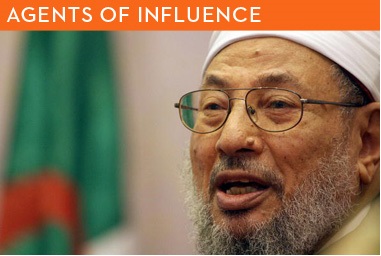
Consequences of Qardhawi seditious stances

Head of the so-called Union of Muslim Ulama in Qatar Sheikh Yusuf Al-Qardhawi has launched a new wave of Iranophobia and Shiaphobia.
While demanding the Sunni youths to be dispatched to Syria to fight on the side of the opposition, Qardhawi claimed that the Iranians intend to kill the Sunnis through pre-planning. The Egyptian Qardhawi residing in Qatar used an insulting language against the leader of the anti-terrorist Lebanese Hezbollah Sayyed Hassan Nasrallah and called him the devil Hassan and Hezbollah as the party of the Satan. Meanwhile the Saudi Mufti Sheikh Abdul-Aziz bin Abdullah bin Muhammad Al-Sheikh voiced his support for the unfounded and biased remarks of Qardhawi against Lebanese Hezbollah and the Islamic Republic of Iran. Living in Qatar for some years, Sheikh Qardhawi has actually turned into a court mullah who has obtained with the support of Aljazeera TV network a status in political circles and the media. The Fatwas of this extremist mullah are aimed at aggravating differences between the Shiites and Sunnis within the framework of the western governments' policy of Iranophobia and Shiaphobia. Unfortunately Qardhawi has been entrapped by the Zionist regime and western governments to ignite sectarian wars in the Islamic states and strengthen the fake Israeli regime. Saudi Arabia and Qatar are the main supporters of the armed groups in Syria who are seeking to overthrow the government of Bashar Assad.
The armed terrorists are fighting the Syrian army within the framework of the policies of the Zionist regime and its western supporters for eliminate Syria from the forefront of resistance against the Zionist regime. Sheikh Qardhawi is one of those who legitimize the measures of terrorists in Syria whereas they are actually destroying the country and the Syrian nation under the pretext of freedom-seeking. Representing the western governments, the extremist armed groups have entered Syria and committed many crimes some of which have been revealed by independent media. Following the failure of terrorist groups in Syria, Qardhawi and the biased and hostile scholars like him are seeking to deceive more youths with their illogical Fatwas and send them to Syria to shed more blood. The Fatwas are in full compliance with the demand of the western states in a manner that Qardhawi has become known as the Sheikh of NATO. He also assured the Zionist regime that the Takfiri groups in Syria pose no threat to the regime.
Leader of the Islamic revolution Ayatollah Sayyed Ali Khamenei in his speech on the day of Mab'ath or the ordainment of Prophet Mohammad (SAWA) emphasized on distancing from discord and the necessity of unity among Muslims. Addressing the reciters and memorizers participating in the 30th international Qur’an Competitions, the leader stressed that one of the important commands of the holy Qur’an to Muslims is preservation of unity and solidarity and said: "Any throat or tongue that calls Muslims to unity is a divine throat and any throat that calls on Muslims and Islamic denominations to fight one another is the throat of Satan." Ayatollah Khamenei added: "One of the Qur’anic commands to Muslims is that they should stick to the rope of Allah all together and avoid disunity. In contrast to this command, there is the colonial teach and method whose aim is to create discord among the Islamic Ummah and intensify sectarian prejudices." The leader said that certain Muslim governments have been deceived and are playing in the enemy's ground. He reiterated: "Unity among Muslims is an urgent necessity.” Leader of the Islamic Revolution said that bloodshed, blind terrorism and the resulting tragedies, and creating opportunities for the usurper Zionist regime are among the consequences of discord among the Islamic Ummah. He added: "Today is the day of a great test for Muslims and Islamic governments, and Muslim nations should be completely vigilant." Ayatollah Khamenei referred to the wave of Islamophobia and stressed: "The Western enemies have unsheathed their swords against Muslims; so the Islamic Ummah should strengthen the factors that contribute to its internal power and capabilities. One of the most important factors in this regard is unity, solidarity and concentration on commonalities." The seditious statements of Qardhawi have widely echoes among Islamic states. The Friday leader of holy Najjaf Seyyed Sadreddin Qabanchi said that instead of inviting Muslims to unity Qardhawi invites them to sedition and his remarks are unacceptable in Islam. The United Ulama Council of Greater Syria in a statement declared as null and voids the so-called Fatwa issued by the controversial Qardhawi sanctioning the killing of fellow Muslims. The council added that Qardhawi’s instigation for bloodshed in Syria is far from the principles of religion, Hadith and practice of the holy Prophet of Islam. The statement declared that the conduct of Qardhawi as the head of the International Muslim Union has questioned the union's credibility. The Algerian daily Al-Watan severely criticized the stances of Qardhawi and wrote: "Sheikh Qardhawi who has several times released Fatwas on the Arab revolutions has no religious sanctity to us anymore, for; he has impudently abused his religious status in the service of Qatari regime's diplomacy.” The Algerian newspaper seriously criticized Qardhawi for his resort to provocative Fatwas aimed at creating sedition in the Arab states. Al-Watan added: "The peace birds which Qardhawi was supposed to lay on the ground flew up and instead of them eagles of war landed.” Regarding Qardhawi’s role in the Syrian crisis, the Algerian daily writes: "The forces of Al-Nusra front who fight the Syrian army always laud the provocative role of Qardhawi.” The British Daily Telegraph in a report on the biased and seditious remarks of Qardhawi wrote: "By inviting the Sunnis for war against the Alavis and Shiites in Syria, Qardhawi showed that he is seeking to intensify religious tensions all over the Middle East.” These are just part of reactions to the seditious remarks of the Egyptian Sheikh who considers permissible the killing of women and children for being Alavi. But are these hostile Fatwas compatible to the Islamic teachings? Which part of the holy Qur’an and the holy Prophet’s practice and behavior says that if a group does not think like us they should be killed? In his entire life the holy Prophet respected the life of those who lived under Muslim conquest but did not embrace Islam as long as they did not resort to arms. The Islamic ruler was mandated to preserve their life just as the life of Muslims. Which Qur’anic ayahs allow Qardhawi to dub the Alavis as worse than the Jews and Christians and shedding their blood Halal? What Qardhawi says about Iran and Shiites is unfounded and results from his hostility towards Shiites. Before becoming an anti-Shiite Sheikh he attended the assembly for proximity of Islamic schools and praised the Lebanese Hezbollah and the status of Seyyed Hassan Nasrallah in countering the Zionist regime. The reality is that differences among Islamic denominations do not cause discord and separation. The Assembly for proximity of Islamic schools was shaped on this idea, for; there are far more commonalities among various religious factions rather than differences. Qardhawi and the Wahabbi mullahs who consider discord among Muslims as their goal are well aware of this point. Therefore they try to introduce the Shiite ideas improperly to the Islamic communities and by distorting the Shiite books they inculcate the lie that the Shiites have no faith in the holy Qur’an. Just like the western regimes portray Islam as promoter and spreader of violence, Qardhawi and the Wahabbis try to create a negative picture of the Shiites. With this propaganda, they want with the aid of Saudi and Qatari rulers to distract attentions from the realities in the Islamic world and push forward their objectives. The objectives that the western governments pursue in the Islamic lands especially in the Middle East are implemented by Qatar and Saudi Arabia and confirmed by Qardhawi.

Monday, July 1, 2013

Intensifying the proxy war in Syria

by Zafar Bangash July, 2013 With the takfiri mercenaries suffering repeated military defeats in recent weeks (they never had any mass support), they and their foreign sponsors have resorted to the most vicious form of sectarian hatred in Syria. With rebel forces on the run in the 27-month long proxy war in Syria, their foreign sponsors have panicked. Led by the US and aided and abetted by Britain, France, Saudi Arabia, Qatar, Jordan and Turkey, the so-called Friends of Syria met in Doha, Qatar on June 22 and pledged more weapons to the rebels. While US Secretary of State John Kerry said they still preferred a political solution to the conflict, their decision to supply more lethal weapons would hardly advance the cause of peace. American officials, however, have always spoken from both sides of their mouth and it is no different in the case of Syria. Only a few weeks earlier, Kerry had urged Russia to convene another conference in Geneva to work out a negotiated settlement to the Syrian conflict. What happens to Geneva-II after Doha? American and British commandos have been training Syrian rebels in Jordan where large stockpiles of weapons are stored for possible use against the Syrian army. Under the guise of conducting military exercises, the real purpose was, and has been for quite some time to train the mercenaries so that they are better able to fight. In recent weeks, the Syrian army has made major gains especially in the strategic town of al-Qusayr with the help of Hizbullah fighters. Located near the Lebanese border, the town has great strategic importance since most of the weapons and mercenaries from Lebanon transited through al-Qusayr. After two weeks of intense fighting, the rebels fled. They had occupied the town for nearly two years destroying it completely. The Syrian army is now closing in on Aleppo to flush the mercenaries from there. The foreign sponsors of the mercenaries see their plans for turning Syria into an imperialist-Zionist outpost unraveling, hence the hurried meeting in Doha.
Nothing demoralizes fighters more than successive defeats. Since they do not enjoy the support of the overwhelming majority of the Syrian people — this was evident from the first day the mayhem was unleashed in March 2011 in a non-descript town like Dar‘a rather than any major city — they are now resorting to more brutal tactics. These are signs of desperation. If people do not join them, their policy is to torture and kill them. Car-bombings, killing leading religious figures like the 84-year-old Shaykh Sa‘id al-Buti in the masjid together with scores of worshippers as well as publicly beheading supporters of President Bashar al-Asad, are standard rebel tactics. They have now turned to cannibalism. By ripping open the body of a dead Syrian soldier and chewing his organs, Abu Sakkar, a well-known rebel commander has shown the rebels’ true face. The video was aired on a rebel website with vows to continue. Such barbarism was witnessed in the Battle of Uhud when Hind, the wife of Abu Sufyan ripped open the body of Hamzah (ra) and chewed his liver in a fit of rage. Muslims then and Muslims now condemn such acts of barbarism and the desecration of dead bodies. Such acts have nothing to do with Islam or its values; this is a return to the days of jahiliyah. This is not the only act of sacrilege perpetrated by the rebels. They slit the throats of children of their opponents and even descecrated the grave of Hujr ibn ‘Adi (ra), a well-known companion of the Prophet (pbuh) who was killed by the Umayyad king, Mu‘awiyah. According to reports, Hujr’s (ra) body was still intact after nearly 1,400 years. He was executed on the orders of Mu‘awiyah because he (Hujr) had objected to the vilification of Imam Ali (a) and Ahl al-Bayt from the minbar. This was a policy instituted by Mu‘awiyah because of his hatred of the family of the noble Messenger (pbuh). Muslims that go berserk and believe it is justifiable to kill fellow Muslims because they criticize some of the Sahabah, have been silent about this sacrilege against the grave and body of a well-known Sahabi. Is it alright to indulge in such behavior if it is perpetrated by people they support? The ongoing mayhem in Syria has exposed a number of players and their true character. First, those leading the so-called Syrian National Council (SNC) have little or no support inside Syria. Most of them reside abroad in five-star hotels or palaces provided by the corrupt Arabian rulers. The regimes supporting rebel fighters who have flooded in from neighboring as well as distant countries, are unrepresentative and tribal dictatorships: Saudi Arabia, Qatar and Jordan. Those calling themselves republican — Turkey, Egypt, etc. — are subservient to the US. The latest addition is President Mohamed Mursi of Egypt. He has disappointed many people both inside Egypt as well as outside by the manner in which he has surrendered to the most oppressive monarchies and to imperialist-Zionist interests. The same goes for Turkish Prime Minister Erdogan. He is already facing a blowback; Mursi will not escape that fate either. While we do not hold any brief for Bashar al-Asad and fully support the right of the Syrian people to have their own representative government, the issue in Syria has gone beyond that. It is an imperialist-Zionist project whose principal aim is to undermine the resistance front against Zionist aggression and occupation, and ultimately push for regime change in Iran. From their affiliations and statements, members of the SNC have exposed themselves as US-Zionist puppets. Those calling for US/NATO intervention should ponder over the plight of Afghanistan, Iraq and especially Libya. Since when has the US or Zionist Israel been friends of the Muslims? What is underway is no longer about the rights of the Syrian people. If the SNC thinks it has mass support in the country, it should participate in next year’s presidential elections and prove it. Destroying Syria to turn it into an imperialist-Zionist outpost will serve the interests of neither the Syrian people, nor of the SNC. Syria is being turned into a hellhole from which only the Israelis will benefit.

Tuesday, January 10, 2012

External powers destabilizing al-Asad regime in Syria

By Tahir Mustafa

Haytham Manna‘, not a lightweight in Syrian opposition circles, has taken a principled position, despite losing relatives in the current situation, to be skeptical of any opposition member that gets its marching orders and weapons from Washington, Paris, Istanbul, or Riyadh (through its Arab League surrogates).

It is now well established that foreign powers are deeply involved in destabilizing the regime of Bashar al-Asad in Syria. Such interference is not confined merely to anti-regime propaganda, although it plays a significant role by presenting misleading reports about civilian casualties to stoke anti-regime sentiment. The tribal-owned network, al-Jazeera, is in the forefront of such propaganda reinforcing the belief that it is working according to a US-Zionist-Saudi script that was agreed upon in Paris as early as February 2011. Recent reports that US forces have been sighted near the Jordanian-Syrian border give credence to the regime’s assertions that it is facing armed attacks from gangs as well as foreign mercenaries. Creation of the Syrian Free Army (SFA) is part of the same plot to provide cover to US-Israeli attacks inside Syria while claiming that defected soldiers are carrying out such attacks. Their number remains relatively small.


Where the foreign powers, including Turkey, miscalculated was in assuming that the Asad regime, like those in Tunisia and Egypt, would collapse quickly. They also made the mistake of assuming that once uprisings are staged in one part of the country — north near the Jordanian border because of easier smuggling of weapons — they would quickly spread to other areas including the capital Damascus. This has not happened. Not only has the regime been able to withstand the pressure, no uprisings have occurred in the two most important cities: Damascus and Aleppo. In fact, massive rallies have been staged in support of the regime that both al-Jazeera and the Washington Post presented as being anti-regime. Such reporting can hardly enhance their credibility.


Haytham Manna‘, chairman of the Arab Human Rights Commission, admitted in an interview with Mandiaal Nieuws (December 9) that people in Damascus and Aleppo are waiting on the sidelines because they are not clear about who or what would follow if Bashar al-Asad were ousted from power. Manna‘’s concern springs from the deep divisions that exist within the ranks of the opposition. The Syrian National Council (SNC) claims to represent all opposition groups and to speak on behalf of all the Syrian people but it has little support inside Syria. Led by Burhan Ghalioun, a Paris-based university professor, its members are mainly Syrian intellectuals in exile. The SNC was cobbled together in Istanbul at the beginning of October. The group held its first congress in Gammarth, north of Tunis, on December 16–18 to agree on a clearer strategy but little came out of the meeting despite its symbolic importance; it coincided with the first anniversary of the Tunisian uprising.


“We need to unite the opposition and make it stronger,” Ghalioun told the AFP news agency. This was a clear admission that the opposition is disunited. It did not help the SNC when a day earlier (December 15) another group of Syrians meeting in Istanbul, announced the formation of the National Alliance. Turkey is beginning to assume the role of headquarters of all Syrian opposition groups. “We need to emerge from this congress with a higher level of organization, clearer targets and more momentum,” Ghalioun said. These appear to have eluded the congress because despite claiming to have agreed to co-ordinate with the Free Syrian Army, the rebels — comprising a tiny minority — are pursuing their own agenda. It is this free for all that has frustrated the emergence of a coherent opposition strategy or how to pursue it. As Manna‘ pointed out, who will replace Asad? The opposition has no clue and this is what makes most Syrians reluctant to join them.


While Syrian opposition groups go through the motions of holding “grand” congresses, “extraordinary” meetings and other high sounding get-togethers, their net result is marginal. This explains why they are so dependent on outside help. The SNC in particular has called for UN intervention although it has stopped short of asking for armed intervention as in Libya, aware of the consequences that would follow. Besides, foreign, mainly Western powers know that Syria is no pushover, unlike Qaddafi’s Libya. The Syrian army and establishment have remained largely intact. There have been no defections of prominent members of the Syrian ruling elite. Defections from the army are small despite the Western media giving them great prominence and presenting them as large.


Perhaps realizing that Asad’s departure was not imminent, the Arab League tried to change its stance. After issuing threats to the Syrian regime to comply with its demands, it has now adopted a more conciliatory approach. The Arab League has never achieved anything in its entire tortuous existence. It is a conglomerate of potentates and tyrants that do not allow any freedom to their own people so how can they expect Asad to comply with their demands. On December 19, Syria signed an agreement with the Arab League to allow foreign observers into the country. Syrian Foreign Minister Walid Muallam said the League had accepted a number of demands put forward by Damascus that included prohibition on visits to military bases or installations. In return, Syria agreed to an immediate end to firing on protesters and allowing League observers to oversee implementation of the agreement.


While opposition groups within Syria are willing to accept the agreement that would end the violence and usher in political reforms even if Asad remained in power, those residing outside are adamant that Asad must go. It is such divisions that have led many Syrians to conclude that opposition groups are incapable of offering them a better alternative to the present set-up. They are also unhappy with foreign-based groups whom they accuse of working at the behest of their foreign sponsors that have no interest in seeing a stable and peaceful Syria. In fact, they feel external powers have their own agenda to engulf Syria in turmoil.


Given that a meeting of Syrian opposition figures had taken place in Paris last February at which plans were agreed to launch an uprising against the Asad regime, gives credence to people’s skepticism. Those present at the Paris meeting included Syria’s former vice president, Abdul Halim Khaddam; Saudi security advisor, Bandar bin Sultan; US Assistant Secretary of State Jeffrey Feltman; US ambassador to Israel, Dan Shapiro; and chairman of the Arab Human Rights Commission, Haytham Manna‘. The line-up of participants is revealing. It was not a meeting of Syrian opposition groups per se but such troublemakers as the US, Israel and Saudi Arabia. Even representatives of the Hariri clan from Lebanon were present.


At the Paris meeting the Saudis and the Americans pushed for smuggling weapons into Syria from Jordan to launch the uprising. Manna‘ was opposed to the idea and so concerned about its consequences that he immediately sent word to the tribal elders in Deraa, his home town, asking them not to allow any weapons to be smuggled in or used in the uprising. Manna‘ rightly feared that it would result in another Hama-type massacre as happened in 1982 and end in similar failure. Manna‘ is no softy. He belongs to a family with a long history of opposition to the regime. His father has spent many years in jail; his brother was killed in the uprising last August but he can see clearly what others are refusing to see. He does not want Syria to emerge with an even worse situation than it currently has.


While the Deraa elders accepted Manna‘’s advice, this did not prevent others from resorting to armed attacks. There have been numerous instances of masked gunmen appearing suddenly and firing indiscriminately at protesters before disappearing. They have also attacked police and other security personnel. While the BBC World Service never tires of reminding its readers about UN estimates of 5,000 people killed in nine months, it fails to mention that these include at least 1,100 security personnel. This is a very large number of police and soldiers to die at the hands of “peaceful” protesters. Further, the figure of 5,000 dead is quite arbitrary. This is based on claims made by opposition spokesmen without providing proof. True, one cannot belittle the number of civilian deaths, it must also be borne in mind that there are external players that want to destabilize Syria as part of the larger plan to undermine the resistance front against Zionist Israel. Manna‘ describes this as “negative intervention,” saying it “destroys but does not create.”


The concern that Syrian opposition figures abroad are working to the US-Israeli game plan is not unfounded. After all, for the US, survival and protection of Zionist Israel takes precedence over all other considerations. If the Asad regime were destroyed, it would deal a severe blow to the resistance front and both the Palestinians and Hizbullah would be exposed to grave danger. Some Syrians argue that their interests cannot be sacrificed for the sake of the Palestinians or Hizbullah. They must explain why they deserve any support or sympathy if they are willing to act as stooges of the US-Zionist duopoly financed by the Saudis?


Manna‘ has been quite clear about why he opposes the Syrian National Council. “I don’t know where it will take us…” He also fears foreign military intervention in Syria and wants change to come about from within. “We want the revolution to be an authentic realization of the people,” and he does not want to see the blood of the people “to be traded or sold — not in Washington, and not in any Arab capital whatsoever.”

Monday, July 4, 2011

Time is running out in the Muslim East


Zafar Bangash is Director of the Institute of Contemporary Islamic Thought

The Islamic Arab East has fire in its belly. The popular mood is: “fa-al-yasqut al-nizam — down with the regime.” Masses of people are breaking the fear barrier and expressing their century-old, pent-up feelings. Some dictators have been toppled, others are teetering, and still others are trying to change laws and make amends before they, too, are swept away by the people’s fury. It all began in Tunisia when a vendor, out of desperation, set himself on fire because the police denied him a permit to sell vegetables to make a living. That one act in a cauldron of seething popular resentment and frustration set off a chain of events that began in Tunisia, immediately followed by Egypt, and then spread to other countries whose people have had it with playboy Pharaohs and tin-pot tyrants along with their drooling luxury classes.

Ever since then, the media has focused attention on this life-sized event. Some media refer to it as the Arab Spring; others call it the Islamic Awakening. Whatever one’s choice of words, the dust has not settled yet. In this popular movement, what is unmistakable is the beginning of the unraveling of the old imposed political order on the Islamic peoples in that geographic area of the world. And the chances are that in a few months, at most a couple of years, other populations will erupt and bring down their own IMF-World Bank sponsored regimes. Already, Greece, Spain and Portugal have witnessed popular protests that threaten the stability of governments in Athens, Madrid, and Lisbon.

Roughly speaking, the popular movements in the southern and eastern Mediterranean fit into three broad categories. The first is the spontaneous or self-generated, as in Tunisia and Egypt.

The second is the pre-existing: examples include Yemen and Jordan. Third, there are the contaminated, such as Libya and Syria. Another category, not much in the news as yet, is what can be characterized as the latent — the ones that are not presently in eruption. Included in this last category are such states as Algeria, Saudi Arabia, Morocco, and the tribal states in the Persian Gulf. The only exception in the Persian Gulf is Bahrain, which may be included in the first category above. Much has been said and written about this excitement and the arousal of these peoples who have one thing in common: they all lack representative government and have been forced to live at the survival level for decades.

Up to this point, no Muslim has any objection. But from here on it gets tricky, messy, ugly, and nasty. Some wet-behind-the-ears Muslims are going to feel uncomfortable with what we have to say; but we are not writing for people to enjoy a comfort zone. The truth sometimes stings. So let us go ahead and say it as it is.

The peoples’ movement (let us call it that) took two opposite camps by surprise. Firstly, it caught the imperialists and Zionists off guard. No one with a functioning mind can deny the fact that the loss of Zine el-Abidine Ben ‘Ali in Tunisia and Hosni Mubarak in Egypt is a grand loss for their remote controllers in Tel Aviv. Now Benjamin Netanyahu and company have no slicked-up proxies in the presidential palaces in Tunis and Cairo. The Israeli political establishment is and has been in damage-control mode ever since. Recent leaks indicate they are working through their American channels to ease out Field Marshal Mohamed Husain Tantawi in Egypt who appears too independent for them. Tantawi is not playing the American card in Egyptian internal politics. The Americans want the September elections postponed because they fear a significant Islamic gain in these “early elections”. And the Israelis are experiencing frequent and watery bowel movements simply because they cannot digest the Egyptian main course.

Secondly, the opposite camp that was taken by surprise was the “Islamists” themselves. Up and down the Islamic political spectrum in Egypt no one was prepared for this type of explosion of the popular will. Not that they feel unhappy about what has happened; on the contrary, most members of the Islamic Movement in Egypt are cheerful and excited that the Pharaoh is gone and they have a chance of rearranging Egyptian society in an Islamic way. Hold on, though: we said “most of the members of the Islamic Movement” — because the dumbed down salafi-Saudis had come out last January at the beginning of the popular movement, saying things like: demonstrations are thankless acts (a‘mal ghayr mahmudah), or that they are a bid‘ah. This word bid‘ah must be their favorite recourse to abort any human ijtihad to do the fara’id (Islamic obligations). The poor enlightened sons of the global Islamic Movement do not have the finances to counter the high decibel Saudi voice of bid‘ah with the word ijtihad. And for Muslims who know their history well, it was that time in Islamic history when the mentality of bid‘ah set in that phased out ijtihad.

And since that time the bid‘ah ‘ulama have reigned supreme. Their heirs are the current Saudi ignoramuses who, in the name of bid‘ah forbid their mothers, daughters, sisters, and wives from driving vehicles. Without going off on a bid‘ah tangent here, even the Islamic Movements beyond Egypt were caught by surprise. And now they are in “catch-up” mode. We dare not think of what Egypt would look like if the well-financed Saudi contingent of the Islamic Movement turns the civilizational and cosmopolitan land of the Nile into an Egyptian version of Saudi Arabia! Imagine a salafi king of Egypt! With all the loops and gaps in the literature of the Islamic Movement no one should be surprised if in the years to come we wind up with a Saudi Arabian Egypt.

Now we get to the nerves and bones of the issue. “Sunni” Muslims, generally speaking, cannot concede the natural right of the people in Bahrain to form their own representative government. The majority population in Bahrain is “Shi‘i”. So, why does any Muslim have second-thoughts about the masses of Bahrainis dethroning a king who is an absolute monarch and whose ambassador to Washington is a Yahudiyah? The Bahrainis, every Muslim should say, have all the right in the world to a representative government; and if that representative government wants closer relations with Islamic Iran than with American Saudi Arabia, all the best to them. No Muslim in Indonesia or Algeria should lose any sleep if the Bahraini people were to rid themselves of a king who has prostituted his country to the American Fifth Fleet (literally).

Now we go to a more sensitive issue. “Shi‘i” Muslims, generally speaking, cannot concede the natural right of the people in Syria to form their own representative government. The majority population in Syria is “Sunni.” So, why does any Muslim have second-thoughts about the Syrian masses unseating a regime that has shown its anti-Islamic colors during the course of the last four decades? Only last year it wanted to host a pan-Arab conference on secularism, which was canceled days before it was to be convened, probably because of positive influence coming out of Tehran. The same regime was doing an Ataturk in the past few years by barring Islamic dress code in government schools. The only argument the Syrian government may have is its support for Hizbullah in Lebanon and the myriad Palestinian resistance groups in Damascus, especially Hamas and Islamic Jihad. The Ba‘thi regime in Damascus, in and of itself, would not have gone so far in supporting Islamic liberation orientations had it not been for positive influence from the Islamic Republic of Iran.

But at the end of the day, the government in Damascus rules the Syrian people, not the Palestinians. So, why can’t a reasonable and levelheaded Muslim concede the right of the Syrian people to have a government that represents them? The inability of the Syrian decision makers to be politically inclusive of their own people is what gives Washington and Tel Aviv inroads into a heartsick and fatalistic population. The stubborn and bloody official policies of the political and military establishments in Syria are playing into Zionist and imperialist hands. The more blood that is spilled in Syria, the more years it will take to stabilize that society — that is if the society can survive these polarizing events. The Muslims in Syria, like Muslims elsewhere, do not have an “Islamic political culture”. In this vacuum, the Saudi Wahhabi nutcases will feed their acolytes the venom of sectarianism. And the sectarianism of “Sunnis” will breed the sectarianism of the “Shi‘is” and this will result in the “Iraqization” of all countries that have a “Sunni-Shi‘i” population in them. Sayyid Hasan Nasrullah was on the mark when he said (and I paraphrase him): “if this thing begins here (in Bilad al-Sham) its fires will rage on into Arabia itself.”

If anyone, anywhere needed the good offices of the Islamic Republic of Iran it is here in this context. Only the Islamic Republic of Iran has the credentials and merit to preempt this sectarian fireball from scorching Syria-south and Arabia-north. A reformed Syria with all its anti-Zionist and pro-Islamic potential is much better than an alternative American-Israeli-Saudi friendly regime that sneaks into power via the victimhood of the Syrian people.


Certainly, Allah does not change the [social] condition of a people until they change their attitude (13:11).